
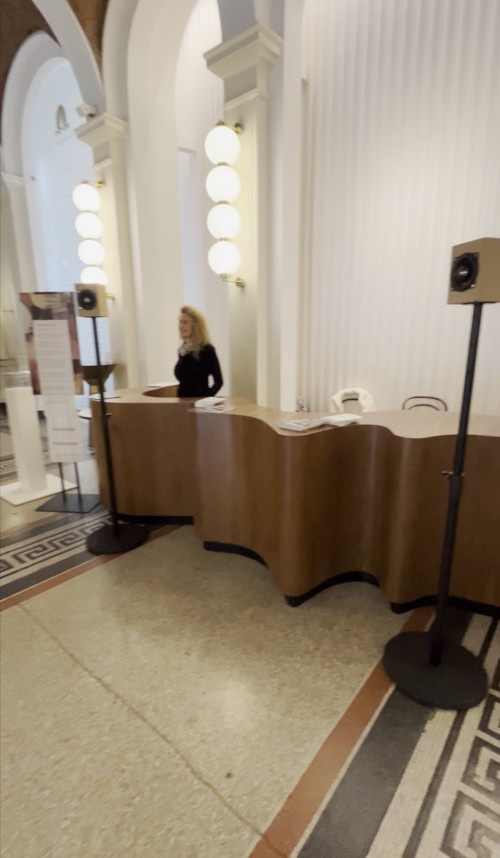
A Spatial Sound Installation – Die Würde des Menschen
This spatial sound installation is focusing on the first sentence of the German “Grundgesetz” (constitution). It says “Die Würde des Menschen ist unantastbar” (Human dignity is sacrosanct). In these crazy times desire arises to protect democracy and human rights and initiate discussions where ever possible.
Watch a short movie about the spatial sound installation at the Hanover Opera House:
Spatial sound installation at Hanover Opera House
You can find the German project description here.
The English project description can be found here.
Spatial audio installation
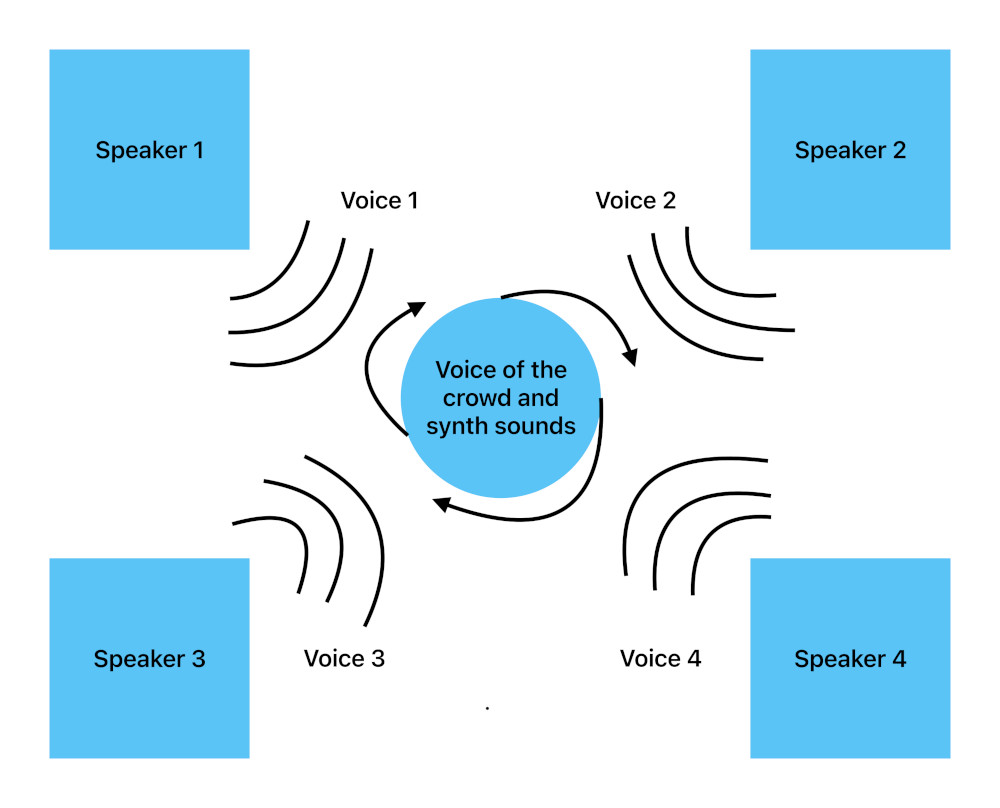
There are four speaker units, with built-in media players, batteries and remote control receivers. Each speaker plays an individual sound file containing the sound tracks allocated to the speaker location as well as the spatial audio part, which is calculated by the spatial sound engine to follow a circular track.
This results in the impression of individual voices coming from the four corners and another sound source of a muttering crowd and synthesizer sounds circulating in the room.
Material
During the Hanover Opera House event we handed out printed cards with the German project description, which you can find below:
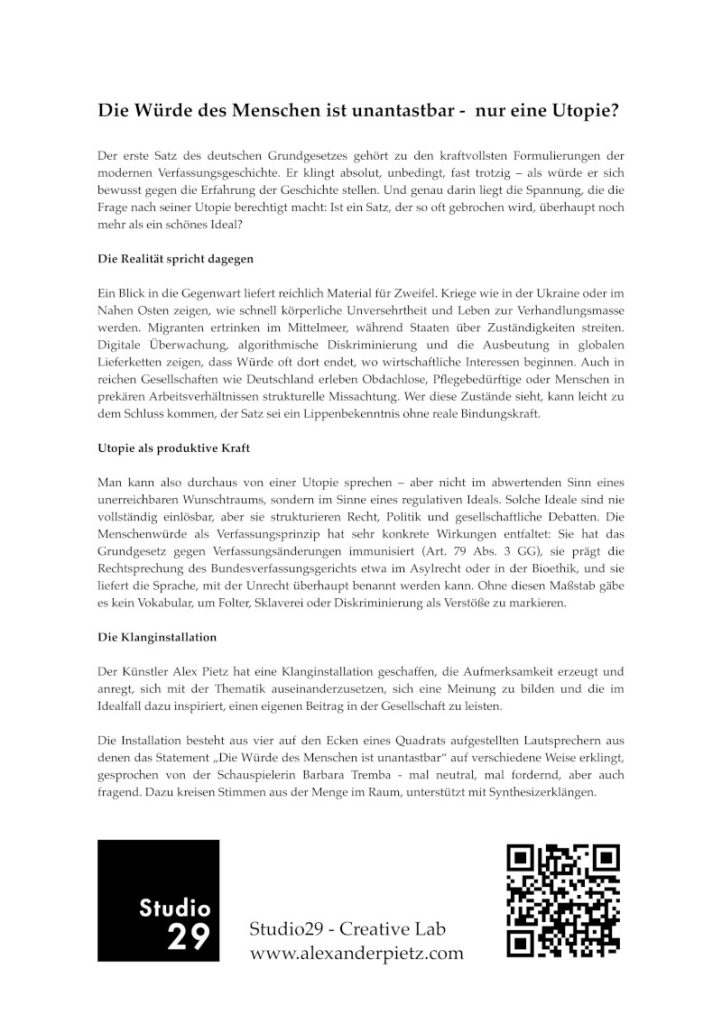
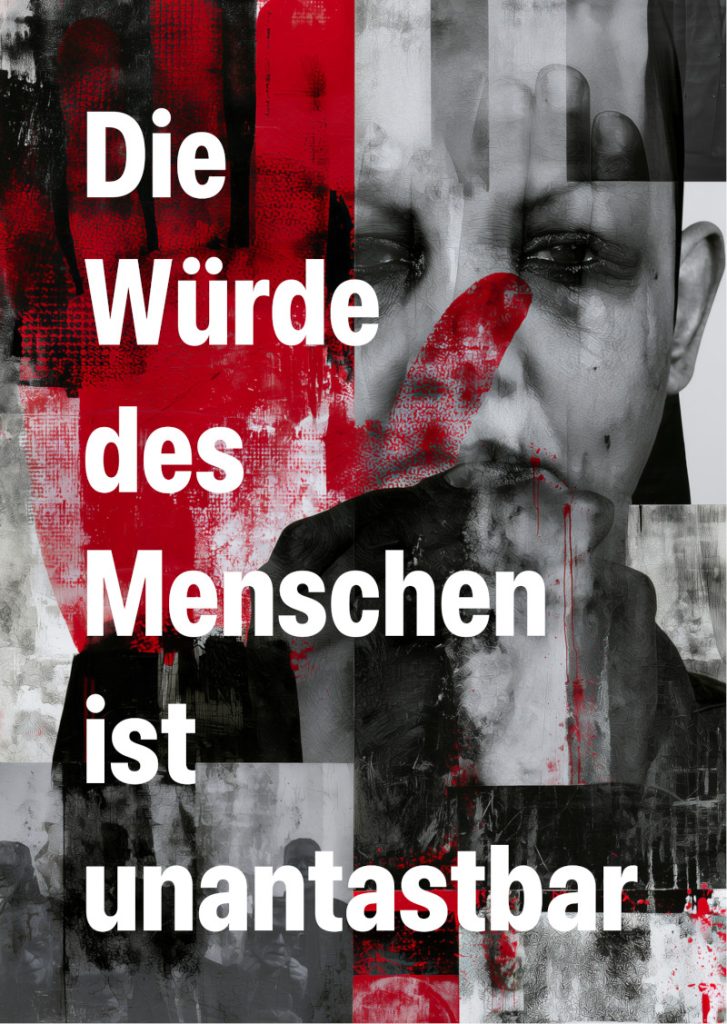
Die Würde des Menschen ist unantastbar – nur eine Utopie?
Der erste Satz des deutschen Grundgesetzes gehört zu den kraftvollsten Formulierungen der modernen Verfassungsgeschichte. Er klingt absolut, unbedingt, fast trotzig – als würde er sich bewusst gegen die Erfahrung der Geschichte stellen. Und genau darin liegt die Spannung, die die Frage nach seiner Utopie berechtigt macht: Ist ein Satz, der so oft gebrochen wird, überhaupt noch mehr als ein schönes Ideal?
Die Realität spricht dagegen
Ein Blick in die Gegenwart liefert reichlich Material für Zweifel. Kriege wie in der Ukraine oder im Nahen Osten zeigen, wie schnell körperliche Unversehrtheit und Leben zur Verhandlungsmasse werden. Migranten ertrinken im Mittelmeer, während Staaten über Zuständigkeiten streiten. Digitale Überwachung, algorithmische Diskriminierung und die Ausbeutung in globalen Lieferketten zeigen, dass Würde oft dort endet, wo wirtschaftliche Interessen beginnen. Auch in reichen Gesellschaften wie Deutschland erleben Obdachlose, Pflegebedürftige oder Menschen in prekären Arbeitsverhältnissen strukturelle Missachtung. Wer diese Zustände sieht, kann leicht zu dem Schluss kommen, der Satz sei ein Lippenbekenntnis ohne reale Bindungskraft.
Utopie als produktive Kraft
Man kann also durchaus von einer Utopie sprechen – aber nicht im abwertenden Sinn eines unerreichbaren Wunschtraums, sondern im Sinne eines regulativen Ideals. Solche Ideale sind nie vollständig einlösbar, aber sie strukturieren Recht, Politik und gesellschaftliche Debatten. Die Menschenwürde als Verfassungsprinzip hat sehr konkrete Wirkungen entfaltet: Sie hat das Grundgesetz gegen Verfassungsänderungen immunisiert (Art. 79 Abs. 3 GG), sie prägt die Rechtsprechung des Bundesverfassungsgerichts etwa im Asylrecht oder in der Bioethik, und sie liefert die Sprache, mit der Unrecht überhaupt benannt werden kann. Ohne diesen Maßstab gäbe es kein Vokabular, um Folter, Sklaverei oder Diskriminierung als Verstöße zu markieren.
Die Klanginstallation
Der Künstler Alex Pietz hat eine Klanginstallation geschaffen, die Aufmerksamkeit erzeugt und anregt, sich mit der Thematik auseinanderzusetzen, sich eine Meinung zu bilden und die im Idealfall dazu inspiriert, einen eigenen Beitrag in der Gesellschaft zu leisten.
Die Installation besteht aus vier auf den Ecken eines Quadrats aufgestellten Lautsprechern aus denen das Statement „Die Würde des Menschen ist unantastbar“ auf verschiedene Weise erklingt, gesprochen von der Schauspielerin Barbara Tremba – mal neutral, mal fordernd, aber auch fragend. Dazu kreisen Stimmen aus der Menge im Raum, unterstützt mit Synthesizerklängen.
Human dignity is sacrosanct – is this merely an utopia?
The first sentence of the German “Grundgesetz” (constitution) is one of the most powerful statements in modern constitutional history. It sounds absolute, unconditional, almost defiant – as if it were deliberately standing in opposition to the lessons of history. And it is precisely here that the tension lies, which justifies the question of whether it is a utopia: is a sentence that is so often violated anything more than a fine ideal?
Reality suggests otherwise
A look at the present provides ample grounds for doubt. Wars such as those in Ukraine or the Middle East show how quickly physical integrity and life become bargaining chips. Migrants are drowning in the Mediterranean whilst states argue over jurisdiction. Digital surveillance, algorithmic discrimination and exploitation in global supply chains show that dignity often ends where economic interests begin. Even in wealthy societies such as Germany, homeless people, those in need of care or people in precarious employment face structural disregard. Anyone who observes these conditions might easily conclude that the phrase is mere lip service with no real binding force.
Utopia as a productive force
One can therefore certainly speak of a utopia – but not in the pejorative sense of an unattainable pipe dream, but rather in the sense of a regulative ideal. Such ideals can never be fully realised, but they shape the law, politics and social debates. Human dignity as a constitutional principle has had very concrete effects: it has immunised the Basic Law against constitutional amendments (Article 79(3) of the German Grundgesetz); it shapes the case law of the Federal Constitutional Court, for example in asylum law or bioethics; and it provides the language by which injustice can be identified in the first place. Without this benchmark, there would be no vocabulary with which to identify torture, slavery or discrimination as violations.
The sound installation
The artist Alex Pietz has created a sound installation that draws attention and encourages people to engage with the subject matter, form their own opinions and, ideally, be inspired to make their own contribution to society.
The installation consists of four loudspeakers positioned at the corners of a square, from which the statement ‘Human dignity is sacrosanct’ is heard in various ways, spoken by the actress Barbara Tremba – sometimes in a neutral tone, sometimes in a demanding tone, but also in a questioning tone. Alongside this, voices from the crowd circulate through the room, accompanied by synthesiser sounds.


